
• Skip to main content
  • Skip to header right navigation
  • Skip to site footer
Worcestershire Industrial Archaeology & Local History Society

Worcestershire Industrial Archaeology & Local History Society

  • Join The Society
  • Programme
    • Current Programme
    • Programme Archive
  • Projects
    • Worcestershire Heritage Map
    • Worcester Electricity Architecture
    • Hidden Histories On Our Streets
    • Barbourne Water Tower
  • Print
    • Publications
    • Newsletter Archive
  • About
    • Our Aims
    • Our Committee
    • Our History
  • Contact

The Architecture of Worcester’s Electricity Department

Contents hide
1 Brief History
2 Hylton Road Station Remains
3 Screening House
4 Substations
5 Street Furniture
6 Map
7 Worcester electricity system diagram
8 Contributors

Brief History

Electricity is provided by private companies today. It was nationalised for much of the 20th century, and before that, power was commonly provided by local authorities. Worcester was one area where its municipal corporation was responsible for power generation and supply.

Powick Power Station, opened in 1894 on the River Teme, was Britain’s first municipally owned hydro-electric station operated long term and the largest of its kind for public supply in the 19th century, initially generating about 400kW and later expanded to 900kW. Developed after Worcester Corporation secured electric lighting powers in 1890, it supplied electricity for waterworks pumps, street lighting, and public buildings, with water and steam used according to demand and river flow.

Growing consumption, particularly from the planned electrification of Worcester’s tramways, led to capacity limits at Powick and the high cost of coal transport, prompting construction of a larger coal-fired steam station at Hylton Road, opened in 1902 and designed to operate alongside Powick.

Permission Granted by Changing Face of Worcester

Hylton Road underwent major expansions in 1922, 1926, and 1945, with substantial wartime rebuilding completed in 1944. The steam plant at Powick closed in 1906, though hydro generation continued until around 1950; the building is now a Grade II listed residential conversion. Following nationalisation in 1948, Hylton Road remained in use until its closure in 1977 and demolition in 1979.

Hylton Road Station Remains

The only remains of the power plant on Hylton road is the base of the north west wall. Here is how it appeared in 2025.

Here is the same position from a photo of the power station before it was demolished in 1979.

Permission Granted by Changing Face of Worcester

Screening House

The Screening House is the only complete building that remains from the generation site on Hylton Road.

It was constructed following a major flood on 1st June 1924. The flood inundated the power station, which was shut down from 07:00 on 2nd June until 06:40 on 3rd June, leaving Worcester without electricity for nearly 23 hours.

The most significant impact was felt at the sewage works (now part of Gheluvelt Park), which also ceased operation as it depended on electricity for pumping, and River Severn flood backed up the Barbourne Brook, which ran alongside the works thereby flooding the site.

At Hylton Road, station staff were unable to access the valves controlling the cooling water supply, as these were submerged beneath the floodwaters. Subsequently, the corporation decided to raise the valves above the maximum flood level by constructing the Screen House around 1925–1926.

They also began considering the provision of standby generation at the Sewage Works. However, the establishment of Stourport Power Station between 1925 and 1927 appears to have made this unnecessary, as there is no record of standby generation being installed. Around this time, a 6.6 kV overhead line was constructed from a 66 kV/6.6 kV transformer connected at 66 kV on the line running from Stourport Power Station to Malvern at Sledgemoor (on the road between Broadheath Crossroads and Martley). The 66 kV compound and overhead line still exist. This line also connected to the Windsor Avenue substation, where the synchronising plant was located, and provided an emergency standby supply to Hylton Road Power Station.

The Screening House was repurposed as an outdoor public art pedestal dubbed The Worcester Plinth between 2024-2025.

Substations

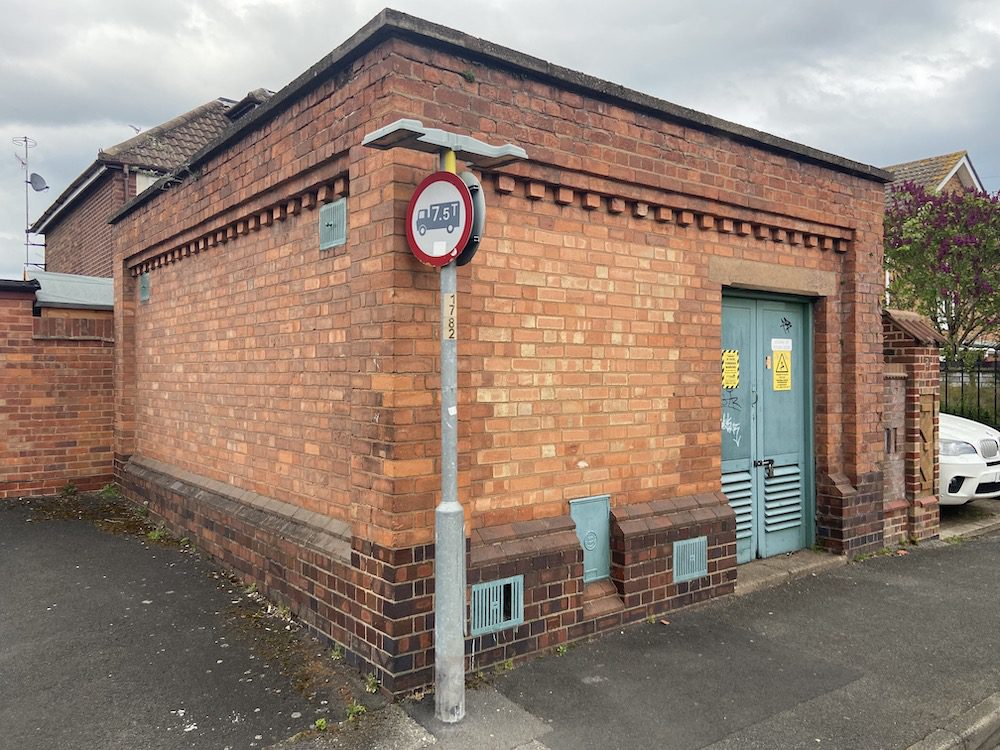
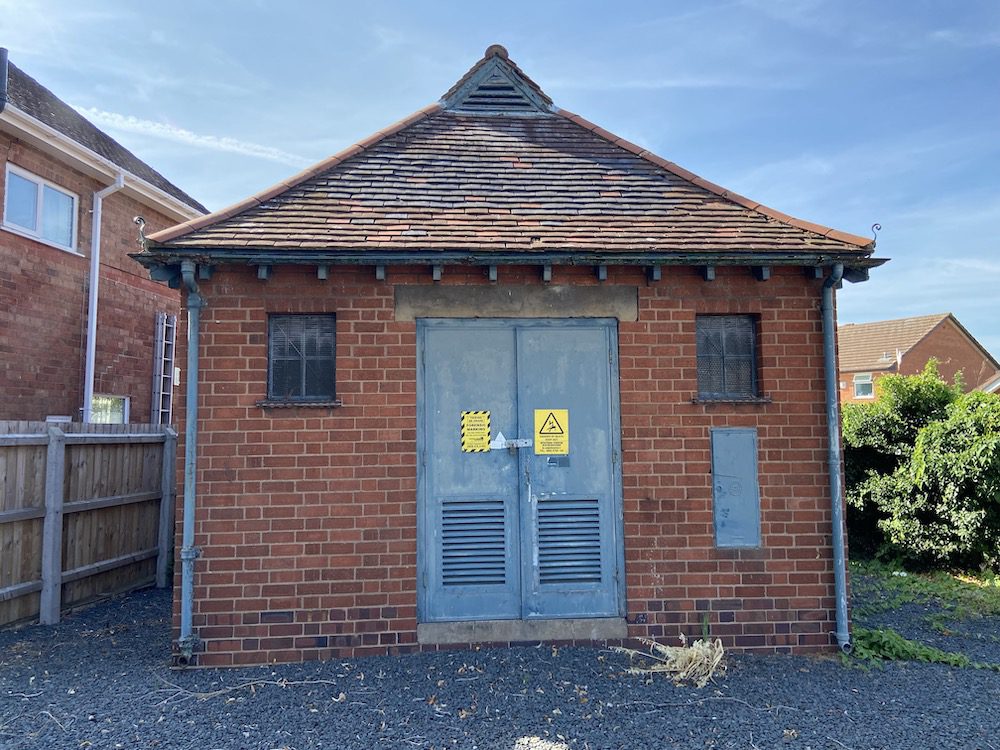
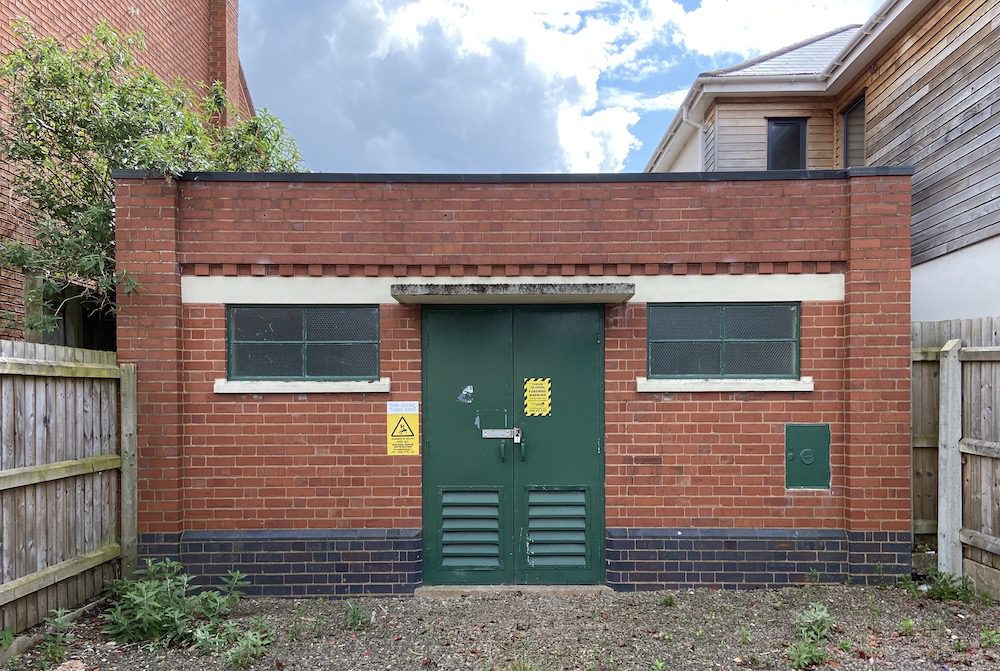
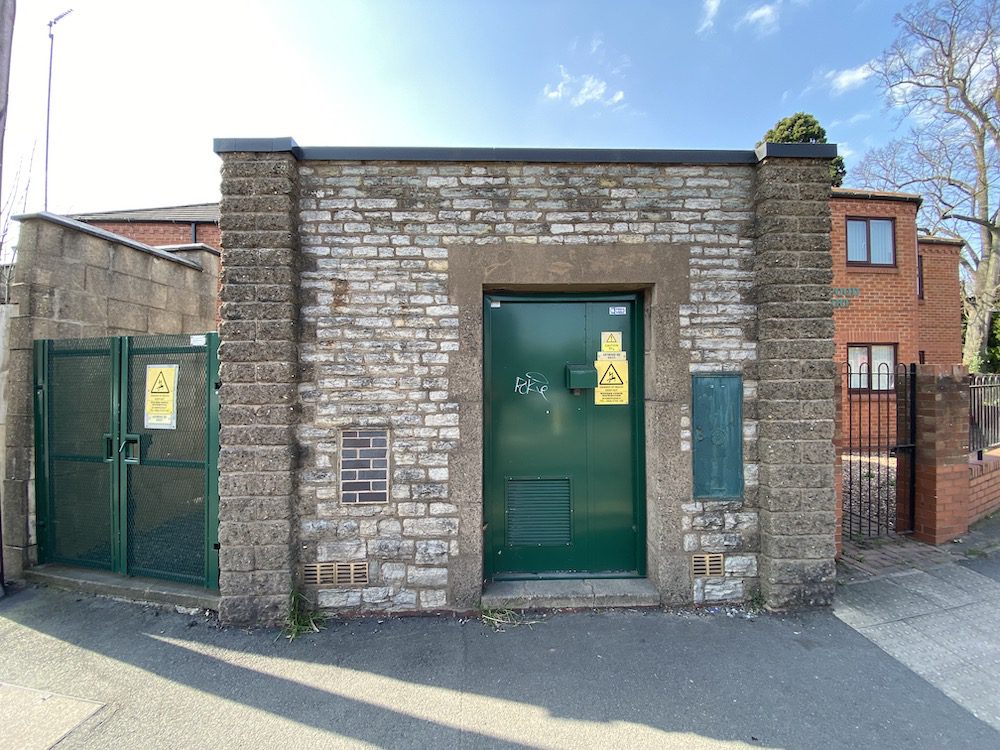
Worcester’s historic substations share a collection of designs that are used repeatedly across multiple locations. We suspect these designs were produced by different contractors who were tasked with building the substations as the electricity distribution network developed over time.

Our favourite design is the brick cubes with castellated corbels such as Crown Street substation. The doors look original.

Many substations resemble sheds and huts such as St Annes Road.

Others adopt art deco features such as the substation on Park Avenue. It reuses the same brick corbels with wide art deco windows, sills and lintol.

The design of some substations is unique. For example, Astwood Road uses stonework that matches the walls of the adjacent cemetery.

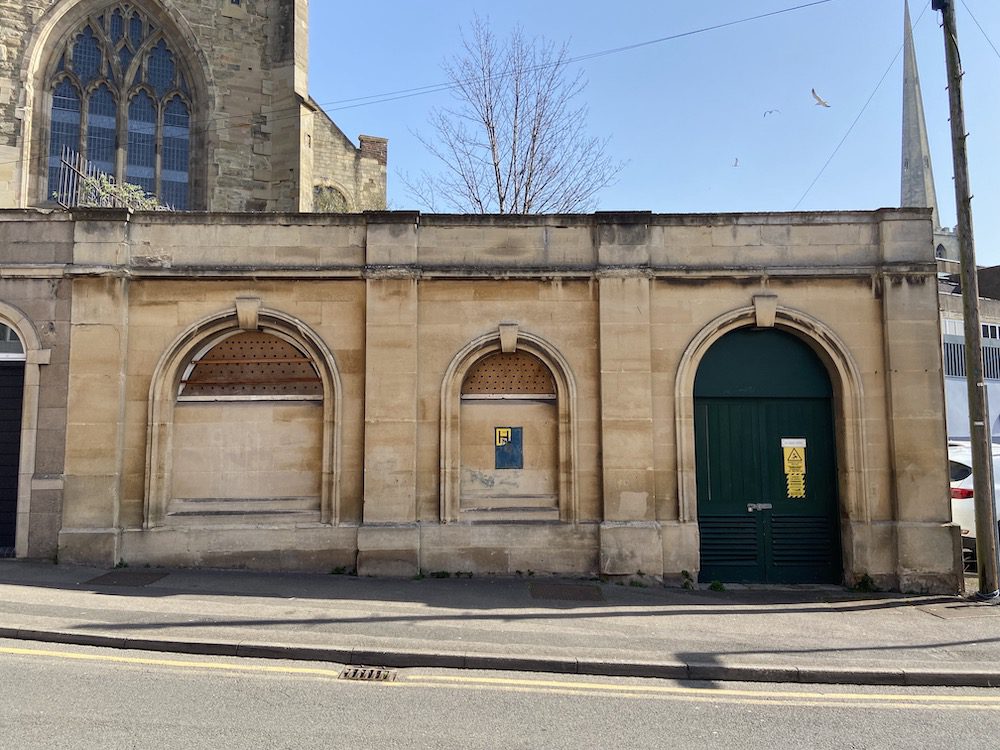
All Saint’s substation is located below the church of the same name and resembles a vault or crypt.

Rainbow Hill substation contains a stone plaque containing 1916 the year of its construction and Worcester’s coat of arms.

This collection of designs is an unrepresented part of Worcester’s charm. It should be given recognition and celebrated as an integral part of the city’s modern development.

Substation Service Doors

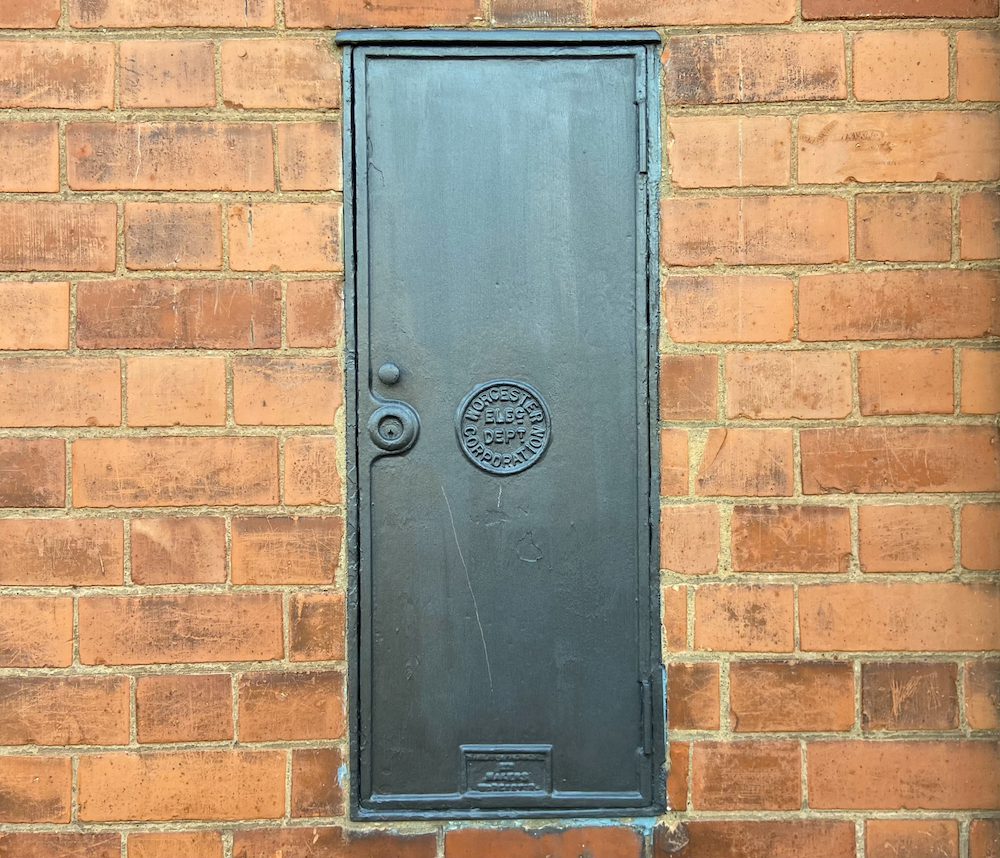
Most of Worcester’s historic substations contain cast iron service doors that come in two sizes. In the examples below, the large door is on Northwick Road and the small door attached to The Guildhall.

These doors, manufactured by Hardy & Padmore and we estimate being cast between 1902, after the construction of the first generating station on Hylton Road, and 1947 when electricity generation and distribution was nationalised.

Why do Worcester’s historic substations have cast iron doors?

The cast iron doors were used by Worcester Corporation Electricity Department officials to access the controls of the city’s original street lighting system because they did not have the required training to enter substations, which are very dangerous. That training was given to engineers working on the electricity distribution system only.

Street Furniture

Worcester Corporation Electricity Department used cast iron feeder pillars to house and protect electrical connections, ensuring a secure point for feeding power to outgoing circuits. The pillars were also cast by Hardy & Pardmore and features the same design of manufacturer marque present on the small substation service doors. We know of three examples in Worcester and one in Great Malvern that still exist as of March 2026.

A feeder pillar in Gheluvelt Park was built to house electrical distribution connections for the Worcester Electric Traction Company that operated the city’s trams from 1902-1926 and was guaranteed by the British Electric Traction (BET) whose logo appears in the centre.

A cast iron sign marking electricity joint cables exists on Astwood Road. A street cover for Worcester Corporation Electric Light using the Brush System also exists outside the antique shop adjacent to the main entrance to Worcester Cathedral at College Precincts.

Map

The following map aims to contain the location of all remains of Worcester’s Electricity Department, namely generating stations, substations, and other tidbits from its infrastructure.

It will become a digital catalogue documenting the architecture of Worcester’s historic electricity distribution system and help you visualise how it covered the city.

Historic buildings in public infrastructures are easily demolished as time progresses. It is important to highlight their architectural merit so we may preserve the story of how these crucial resources came into existence.

Worcester electricity system diagram

The following image is an excerpt of Worcester’s EHT system diagram. It details the names of all electricity transformers as they were in 1957. A high resolution of the diagram is available here.
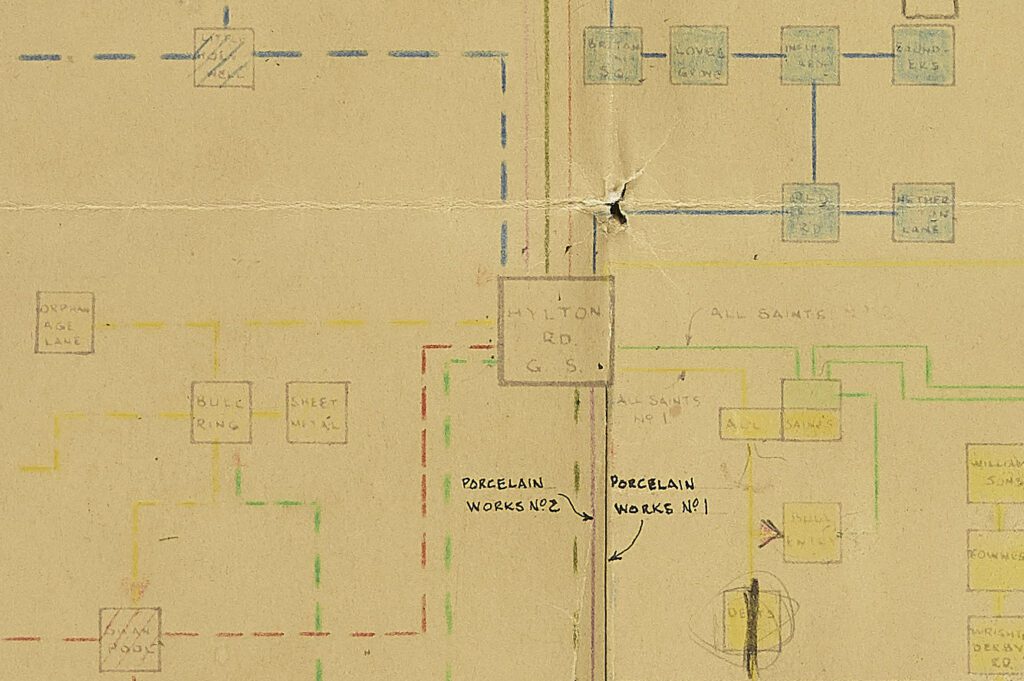
All efforts have been taken to identify the copyright owners. We welcome the owners to contact us.

Contributors

A big thank you to Sheena Payne-Lunn, Brian Garrett, and Tim Onions for your valuable input on this project, which was proud to support The Power of Worcester community arts project created by Crave Arts with funding from Heritage Lottery.

Discover the history of Worcestershire

Join over 150 members

Join the society

Navigation

Our Aims
Programme
Projects
Publications
Newsletter
Contact
Links

Follow us

  • Facebook
  • Twitter

Legal

Privacy Policy
Cookie Policy
Website Terms
Safeguarding Policy

Copyright © 2026 · All Rights Reserved